3 min readNutrition & Diet Analytics
Low-FODMAP for lifters: hitting 160g protein when your gut hates everything
Whey bloats you, beans are off the table, and most protein bars are a FODMAP minefield. Here is how to hit a serious protein target on a low-FODMAP diet without triggering a flare — and how Misi plans it.
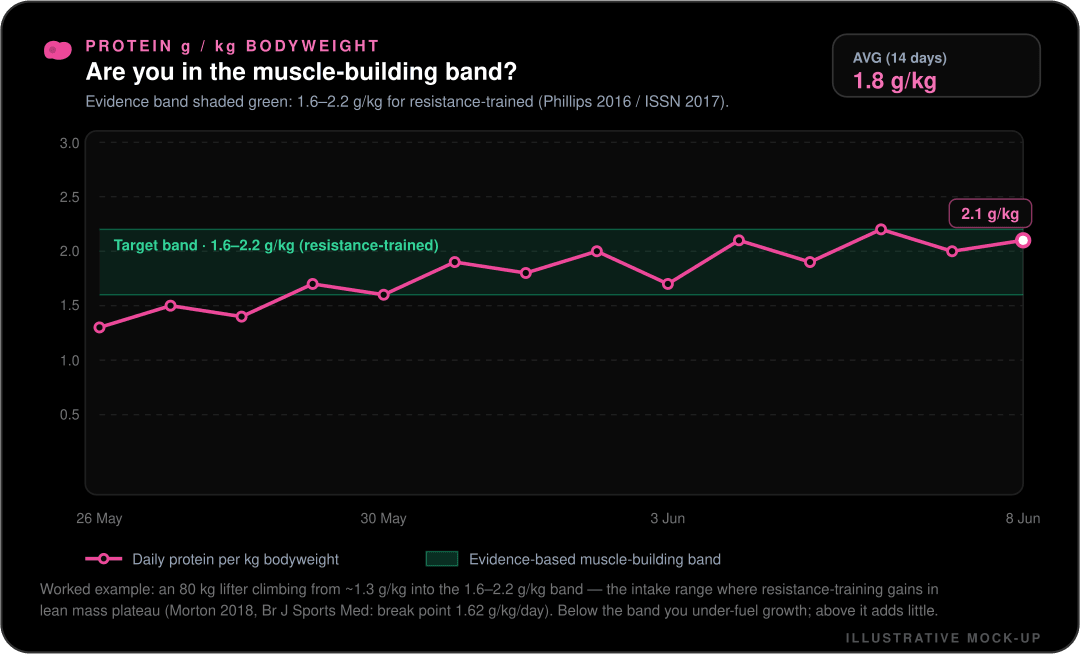
Part 43 of 51This article is part of the Nutrition & Diet Analytics guideBuilding muscle needs a lot of protein — 1.6 to 2.2 g per kg of bodyweight, which for many lifters means 140 to 180 g a day. Doing that on a low-FODMAP diet feels almost contradictory: the convenient high-protein staples are exactly the ones that set off your gut. Whey concentrate bloats you, beans and lentils are out during elimination, and half the protein bars on the shelf are sweetened with polyols that guarantee a flare. It is a real problem, and it is solvable. (For the protocol basics, see our low-FODMAP planning guide.)
Why protein and low-FODMAP collide
The clash is specific. Legumes — beans, lentils, chickpeas — are among the best plant proteins but are high in the oligosaccharides (GOS) that FODMAP-sensitive guts cannot handle in volume. Whey protein concentrate retains enough lactose to bother lactose-intolerant users. And "high-protein" processed snacks are frequently loaded with inulin, chicory root or polyol sweeteners (sorbitol, mannitol, xylitol) that are textbook triggers. The result is that the obvious ways to add protein are often the exact ways to provoke symptoms.
The low-FODMAP protein staples that work
The good news is that most pure animal proteins contain no FODMAPs at all — meat, poultry, fish and eggs are naturally low-FODMAP and should form the backbone of your intake. Among supplements, whey protein isolate (as opposed to concentrate) has had most of its lactose removed and is generally well tolerated, and rice or egg-white protein powders are safe alternatives. Firm tofu is low-FODMAP even though other soy forms are not, hard cheeses are low in lactose, and lactose-free dairy and small portions of certain nuts round out the list. There is more than enough here to build 160 g a day.
Watch the portion thresholds, not just the food
A crucial low-FODMAP subtlety: many foods are safe in a small portion and problematic in a large one, because FODMAPs stack. This matters enormously for lifters, who eat bigger portions than the Monash test serving assumes. A quantity of almonds or a serving of yoghurt that is "green" at 30 g can turn "red" when you double it to hit your macros. Managing protein on low-FODMAP is as much about portion size and cumulative load across the day as it is about which foods appear on the list.
Spread it across the day for muscle and for tolerance
Distributing protein across four or so meals — roughly 0.4 g/kg each, clearing the leucine threshold — is optimal for muscle protein synthesis anyway, and it doubles as a FODMAP strategy: smaller protein servings mean smaller FODMAP loads per sitting, keeping you under your gut’s threshold. What is good for hypertrophy is, conveniently, also good for your gut here.
How Misi plans it without the spreadsheet
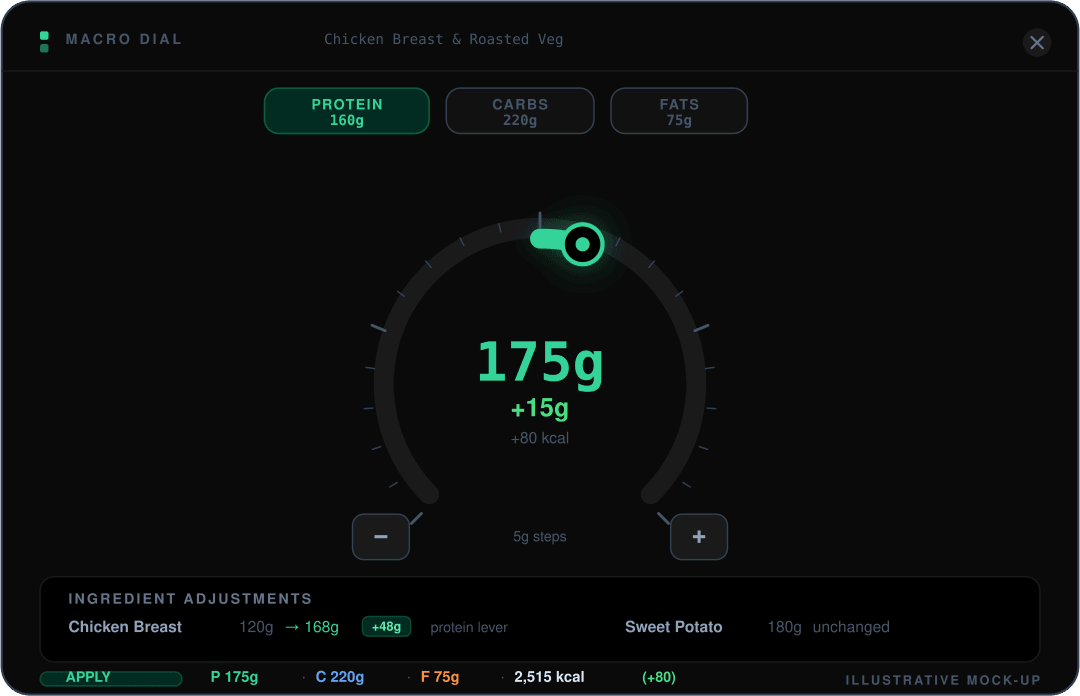
This is exactly the kind of two-constraint problem software is built for. Misi plans from a curated, lab-checked database, filtering for low-FODMAP-friendly meals while still hitting your protein and macro targets within a tight tolerance — so you do not have to cross-reference a food list against your macro sheet at every meal. It tracks protein per kilogram to confirm you are in the muscle-building band, and the shopping list and prep guide are built around the same gut-safe meals. Hitting 160 g of protein without a flare stops being a daily puzzle.
A sensitive gut does not mean you cannot build muscle. It means being deliberate: lean on naturally low-FODMAP proteins, respect the portion thresholds, and spread the load across the day.
This is general information, not medical advice. A low-FODMAP diet is best run with a registered dietitian, especially through reintroduction, and is not meant to be followed strictly long-term. Anyone with kidney disease should discuss high protein intake with a clinician.
Ready to put this into practice?
Misi BioLabs turns your bloods into a meal plan, training block and AI coaching — in one place.
Start freeFree tools
- PhenoAge Calculator — Biological age from a standard blood panel (Levine 2018).
- Biological Age Calculator — How fast are you really ageing? Nine blood markers answer it — no quiz.
- VO2max Calculator — Cooper 12-minute test → VO2max + fitness age + mortality hazard.