3 min readLongevity & Biological Age
How to raise your VO2max by one MET (and why that’s a 12% mortality drop)
A single MET of extra fitness is linked to a double-digit fall in mortality risk — one of the best returns in all of health. Here is exactly how to train for it, and how long it takes.
Part 5 of 23This article is part of the Longevity & Biological Age guideOne of the most striking findings in exercise science is also one of the most actionable: raising your cardiorespiratory fitness by a single MET — one metabolic equivalent, a modest step up in VO2max — is associated with a meaningful drop in your risk of dying, on the order of 10 to 15% (Kodama 2009, JAMA). Few interventions in all of medicine offer that return. The question this post answers is the practical one the mortality studies skip: how do you actually add that MET? (For the full case on why VO2max predicts lifespan, see our VO2max explainer.)
What one MET actually means
A MET is a unit of energy expenditure: one MET is your resting metabolic rate, and VO2max is often expressed in METs (or in ml of oxygen per kg per minute — one MET is about 3.5 of those units). Adding one MET means nudging your peak aerobic capacity up by roughly 3.5 ml/kg/min. In practical terms that might be the difference between struggling on a brisk hill and cruising up it — a real, felt improvement, not just a number. For most untrained or moderately trained people it is an entirely achievable target over a training block.
The engine: build the base with zone 2
The foundation of a bigger aerobic engine is volume at an easy intensity — zone 2, the pace at which you can still hold a conversation. This is where mitochondrial density and capillary networks grow, expanding the base that everything else sits on. Aim for the bulk of your weekly cardio here: three or more sessions of 30 to 60 minutes. It feels almost too easy, which is exactly why most people skip it and stall. (Our Zone 2 vs intervals piece goes deeper on the split.)
The ceiling: raise it with intervals
Zone 2 builds the base; high-intensity intervals raise the ceiling — and it is the ceiling that VO2max measures. The best-evidenced protocol is the Norwegian 4x4: four four-minute efforts at around 90 to 95% of maximum heart rate, each followed by three minutes of easy recovery, once or twice a week (Helgerud 2007). This near-maximal work is the specific stimulus that pushes peak oxygen uptake up. One or two interval sessions a week, on top of your zone-2 base, is the combination that moves the number.
How long it takes
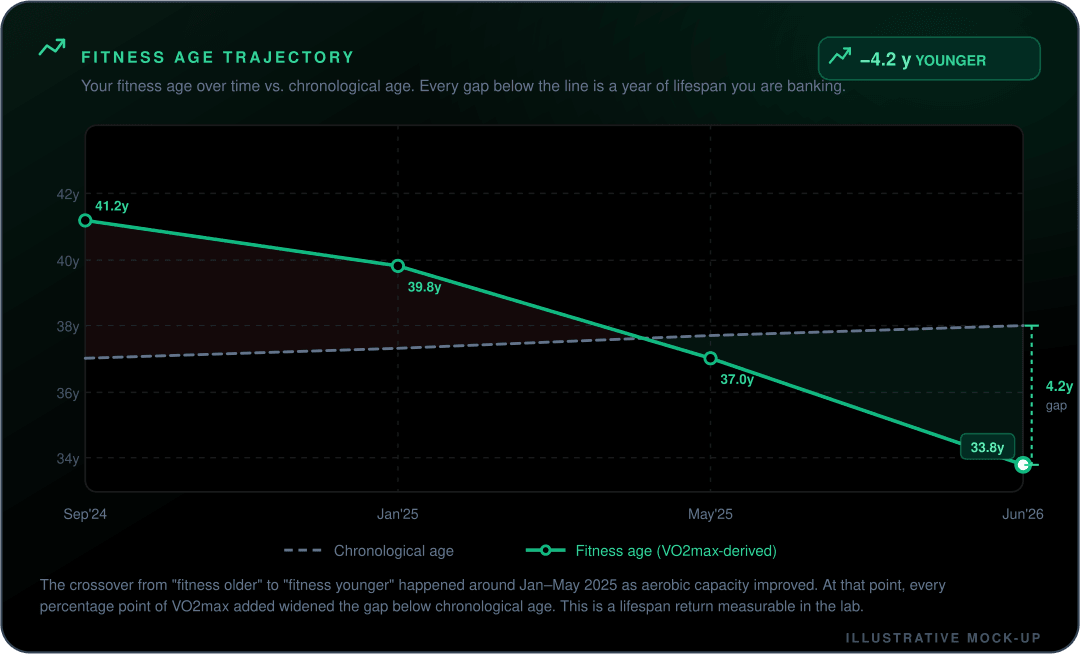
Realistically, a consistent block of 8 to 12 weeks combining a zone-2 base with twice-weekly intervals can add a MET or more, especially if you are starting from a lower base where gains come fastest. The people who get there are not the ones who train ferociously for two weeks — they are the ones who hold the polarised structure steady for a couple of months. Fitness responds to consistency, and this is a marker that rewards patience.
How Misi trains it and tracks it
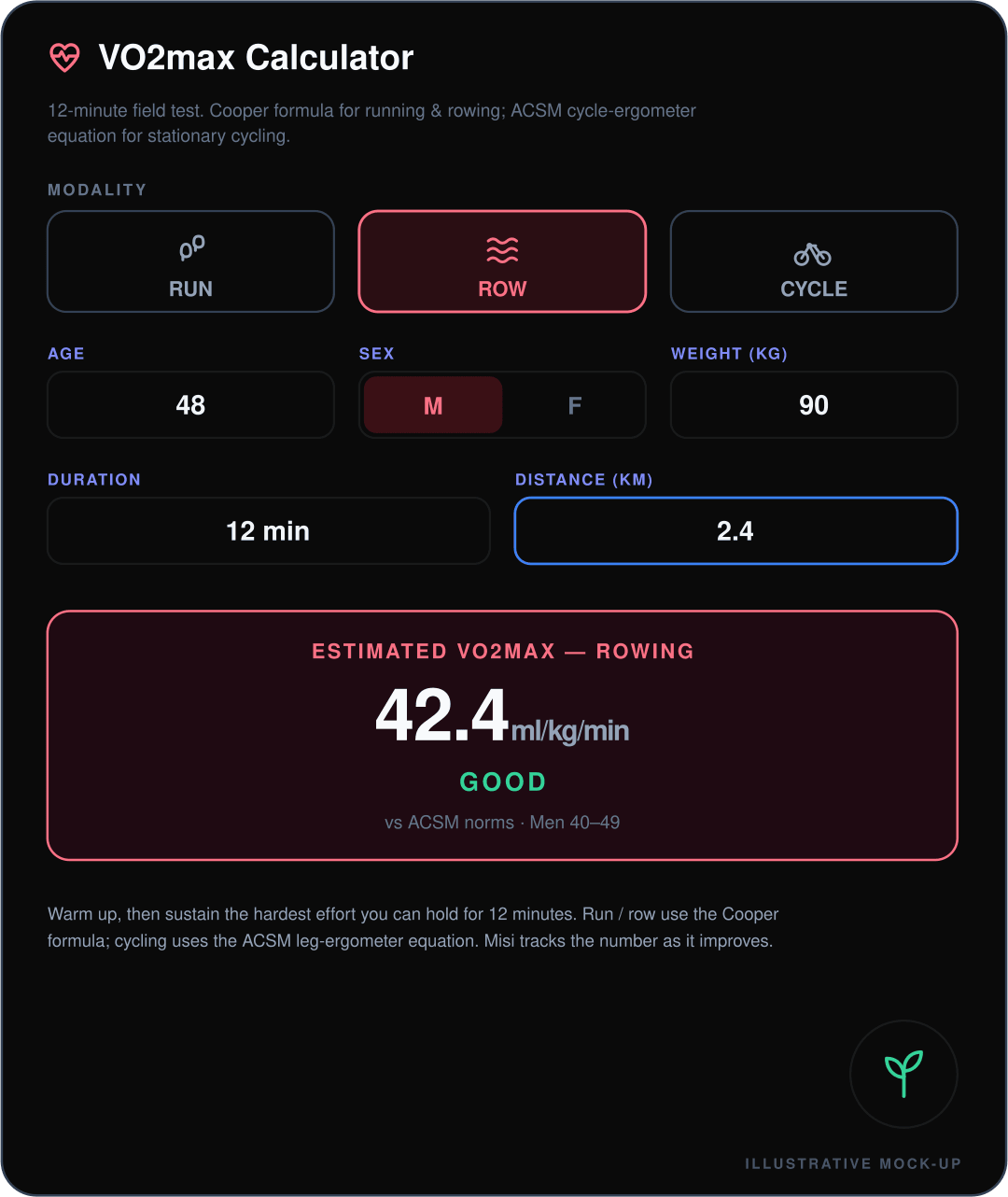
Misi structures both speeds for you: its cardio engine holds zone-2 sessions in the right heart-rate band, and its HIIT engine builds the near-maximal interval work that raises the ceiling. It then estimates your VO2max from a field test and charts it — along with your fitness age — over time, so a one-MET improvement becomes a visible, verified result rather than a guess. You get the training that adds the MET and the measurement that proves it.
One extra MET of fitness buys a double-digit cut in mortality risk. The recipe is not exotic: a big zone-2 base, a small dose of hard intervals, held steady for a couple of months.
This is general fitness information, not medical advice. High-intensity intervals place real demand on the heart — if you are new to exercise, returning after a break, or have any cardiovascular or respiratory condition, get clearance from a clinician before starting.
Ready to put this into practice?
Misi BioLabs turns your bloods into a meal plan, training block and AI coaching — in one place.
Start freeFree tools
- PhenoAge Calculator — Biological age from a standard blood panel (Levine 2018).
- Biological Age Calculator — How fast are you really ageing? Nine blood markers answer it — no quiz.
- VO2max Calculator — Cooper 12-minute test → VO2max + fitness age + mortality hazard.