4 min readProtein & Muscle
How much protein actually builds muscle — and why leucine pulls the trigger
Building muscle comes down to two numbers most people never track: how much total protein you eat per kilogram of bodyweight, and how much leucine lands in each meal. Misi plots both against the evidence.
Part 1 of 10This article is part of the Protein & Muscle guideAsk ten people how to build muscle and you will get ten answers about splits, rep ranges and supplements. Almost none will mention the two variables with the strongest evidence behind them: your total daily protein relative to your bodyweight, and the amount of leucine in each individual meal. Get those right, train hard, and growth follows. Misi exists to make both visible.
Total protein is the volume that drives growth
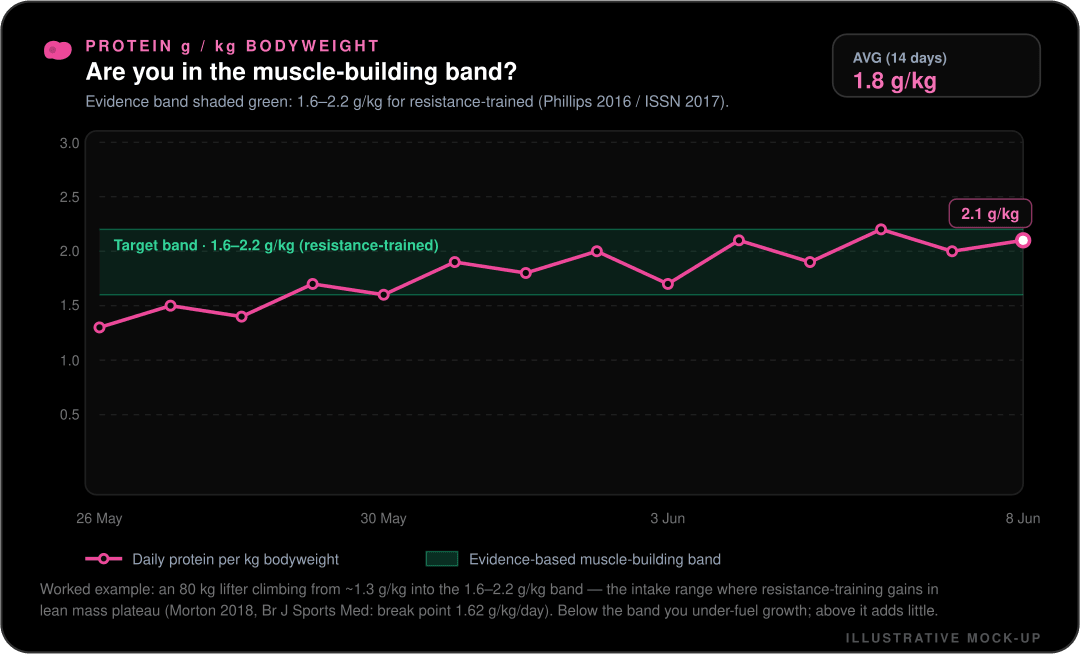
The headline number is grams of protein per kilogram of bodyweight per day. A 2018 meta-analysis by Morton and colleagues in the British Journal of Sports Medicine pooled 49 randomised trials and 1,863 participants, and found that gains in lean mass kept rising with protein intake up to a break point of about 1.62 g/kg/day (95% confidence interval 1.03 to 2.20), after which extra protein added little. Because the upper end of that interval reaches 2.2 g/kg, the authors note it is prudent to aim toward the top of the range if your goal is to maximise muscle. The standard RDA of 0.8 g/kg — set to prevent deficiency, not to build tissue — is simply too low for anyone training seriously, and the International Society of Sports Nutrition position stand (Jager 2017) recommends 1.4 to 2.0 g/kg/day for building and maintaining muscle.
Why a per-kilogram target beats a flat gram goal
A flat target like "150g of protein" means very different things for a 60 kg and a 100 kg person. Tying the goal to bodyweight is what makes it personal: the same 1.6 to 2.2 g/kg band scales to whoever you are. The chart above does that maths automatically, dividing your logged protein by your bodyweight each day so you can see — at a glance — whether you are actually inside the range that the trials reward, rather than guessing from a single round number.
Total is only half the story — leucine is the trigger
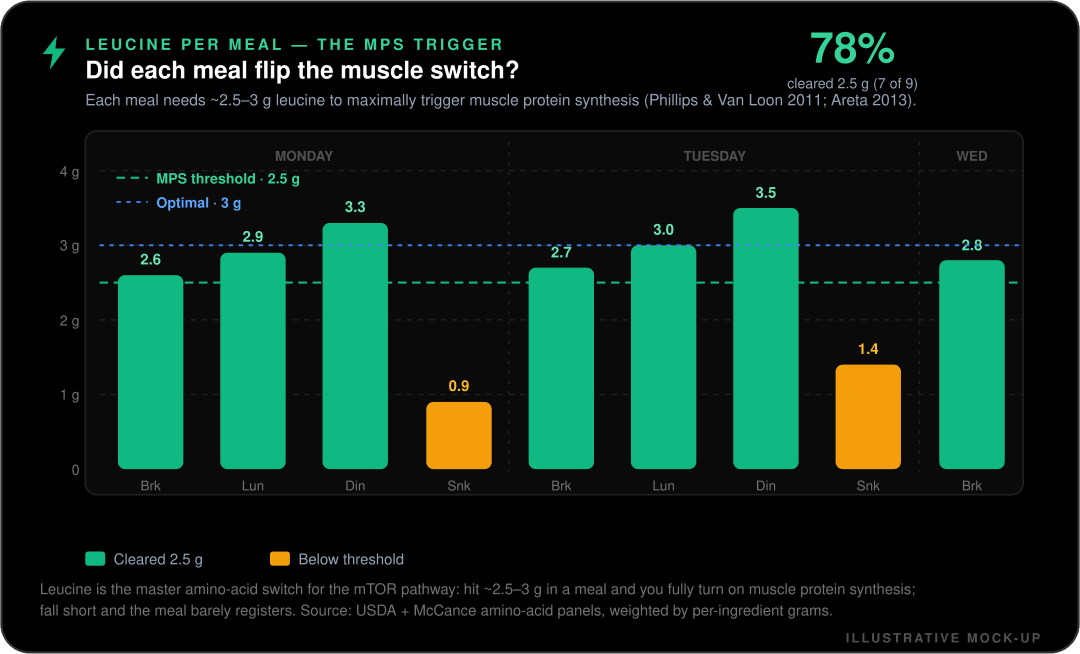
Hitting your daily total matters, but muscle is built meal by meal, and each meal has to clear a separate bar. Muscle protein synthesis — the process that turns the protein you eat into new tissue — is switched on through the mTOR pathway, and the single amino acid that flips that switch is leucine. Below roughly 2.5 to 3 grams of leucine in a meal, the response is muted; cross that threshold and you maximally stimulate synthesis (Phillips & Van Loon 2011, Journal of Sports Sciences; Norton & Layman 2006). Leucine is, in effect, the master amino-acid switch for muscle growth.
How to track your leucine in the app
Leucine is not on a nutrition label, which is why almost nobody tracks it — yet it is the variable that decides whether a meal actually counts. Misi calculates it for you. Every meal you log is broken down to its ingredients, and the app weights each ingredient's leucine content (from USDA and McCance amino-acid panels) by the grams you ate, then totals it. The "Leucine per meal" chart then shows each meal against the 2.5 g threshold, with a clear running figure — here, 78% of recent meals cleared it. A breakfast or snack that comes up amber is your cue to add a leucine-rich food, not just more calories.
Spread the protein across the day
Because each meal has to clear the leucine threshold on its own, how you distribute protein matters as much as the daily total. Areta and colleagues (2013, Journal of Physiology) showed that four feedings of about 20g every three hours stimulated muscle protein synthesis more effectively over a day than either a few large boluses or many tiny servings. The practical target most researchers converge on is roughly 0.4 g of protein per kilogram per meal across three to four meals (Schoenfeld & Aragon 2018) — enough to deliver the leucine each one needs. Three solid meals that each clear the threshold beat one giant protein hit and two that barely register.
Your daily protein total gets you to the door. Leucine, meal by meal, is what actually opens it.
These are population guidelines, not medical advice. Protein needs vary with training, body composition and health status, and anyone with kidney disease or other medical conditions should speak to a clinician before substantially raising protein intake.
Ready to put this into practice?
Misi BioLabs turns your bloods into a meal plan, training block and AI coaching — in one place.
Start freeFree tools
- PhenoAge Calculator — Biological age from a standard blood panel (Levine 2018).
- Biological Age Calculator — How fast are you really ageing? Nine blood markers answer it — no quiz.
- VO2max Calculator — Cooper 12-minute test → VO2max + fitness age + mortality hazard.