3 min readProtein & Muscle
Protein quality, not just quantity — why leucine decides if a meal counts
Two meals can have the same protein on the label and do completely different things to your muscle. The difference is amino-acid quality — and above all, leucine. Here is how to tell, and how Misi tracks it.
Part 2 of 10This article is part of the Protein & Muscle guideYou can hit your daily protein target to the gram and still leave muscle on the table. The reason is that "protein" on a nutrition label is a crude measure — it counts nitrogen, not usefulness. Two 30g servings of protein can deliver very different amounts of the amino acids that actually build muscle. Quality, not just quantity, is what turns a number on a label into new tissue.
Quality means the amino acids, not the gram count
Protein quality is about two things: the profile of essential amino acids a food contains, and how well you digest and absorb them. The modern gold-standard score is DIAAS (Digestible Indispensable Amino Acid Score), introduced by the FAO in 2013 to replace the older PDCAAS. By that measure, dairy, egg and meat proteins score highest, while many plant proteins fall short on one or more essential amino acids — typically lysine in grains and methionine in legumes — and are less completely digested. A high gram count from a low-quality source can still leave you short on what matters.
Leucine is the master switch
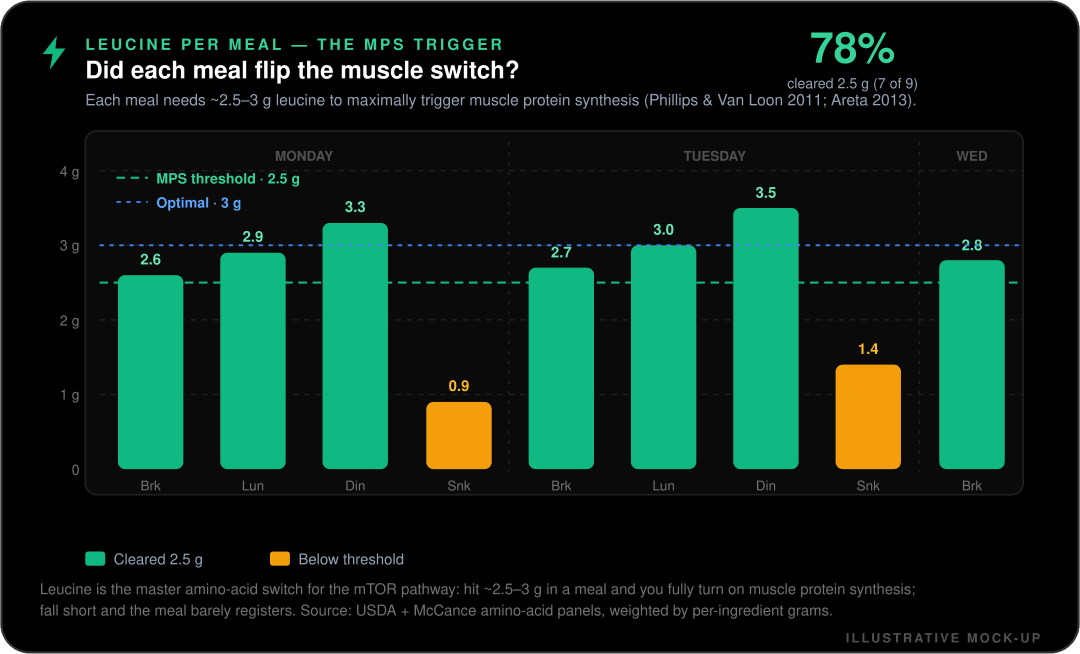
Among the essential amino acids, one does most of the signalling work: leucine. It independently activates the mTOR pathway that triggers muscle protein synthesis, which is why researchers describe a "leucine threshold" — roughly 2.5 to 3 grams in a meal — that a feeding has to cross to maximally switch synthesis on (Norton & Layman 2006). This is the real reason quality matters: high-quality proteins are not just more digestible, they are denser in leucine, so they reach the threshold in a smaller, more realistic portion.
Why animal and plant proteins are not interchangeable
Leucine makes up roughly 10 to 11% of whey protein, around 8 to 9% of most animal, dairy and egg proteins, but often only 6 to 8% of plant proteins. That difference is decisive at the meal level. Tang and colleagues (2009, Journal of Applied Physiology) directly compared the acute response after exercise and found whey stimulated synthesis more than casein, and casein more than soy — driven by leucine content and digestion speed. None of this makes plant protein "bad"; it simply means the same 30g of protein from soy or pea delivers less leucine than 30g from whey or chicken, and may sit below the threshold.
How to lift a low-quality meal over the line
If you eat mostly or entirely plant-based, the fix is straightforward once you can see the gap. Use slightly larger protein portions to offset the lower leucine density; combine complementary sources in one meal — grains with legumes — so their limiting amino acids cover each other; lean on the higher-leucine plant options such as soy and lentils; or add a leucine-rich element. Van Vliet and colleagues (2015) detail why plant proteins are less anabolic per gram and how dose and blending close the difference. The goal is not to abandon plants — it is to make each meal clear the threshold.
Track it in the app
Because leucine never appears on a label, the only practical way to manage it is to have it calculated for you. Misi breaks every logged meal down to its ingredients, weights each one's leucine by the grams eaten using USDA and McCance amino-acid panels, and plots the total against the 2.5 g threshold. An amber bar tells you immediately that a meal was high in protein but low in quality — and exactly which meals to upgrade.
The label tells you how much protein you ate. Leucine tells you how much of it your muscles could actually use.
This is general nutrition information, not medical advice. Anyone with a medical condition, particularly kidney disease, should consult a clinician before making significant changes to protein intake.
Ready to put this into practice?
Misi BioLabs turns your bloods into a meal plan, training block and AI coaching — in one place.
Start freeFree tools
- PhenoAge Calculator — Biological age from a standard blood panel (Levine 2018).
- Biological Age Calculator — How fast are you really ageing? Nine blood markers answer it — no quiz.
- VO2max Calculator — Cooper 12-minute test → VO2max + fitness age + mortality hazard.