3 min readLongevity & Biological Age
Protein, muscle and a longer life — why skeletal muscle is your retirement fund
Muscle is not just for the gym. It is metabolic reserve, fall protection and one of the strongest predictors of how well you age. And protecting it means raising your protein target as you get older, not lowering it.
Part 9 of 23This article is part of the Longevity & Biological Age guideMost people think of muscle as a vanity project — something for athletes and the gym crowd. The longevity research tells a very different story. Skeletal muscle is an organ of metabolic health and resilience, and how much of it you carry into your later decades is one of the strongest predictors of how well, and how long, you live. Protein is the raw material that protects it.
Muscle is the organ of longevity
From around the age of 30, adults lose roughly 3 to 8% of their muscle mass per decade, and the rate accelerates after 60 — a process called sarcopenia. That loss is not just about looking frail: muscle is where you dispose of blood glucose, it is your protein reserve when illness or surgery hits, and it is what keeps you upright and stops a fall becoming a fractured hip. In a large analysis of NHANES data, Srikanthan and Karlamangla (2014, American Journal of Medicine) found that higher muscle mass relative to body size was associated with lower all-cause mortality in older adults. Put bluntly, the muscle you build now is a reserve you draw on later.
The protein target climbs with age — it does not fall
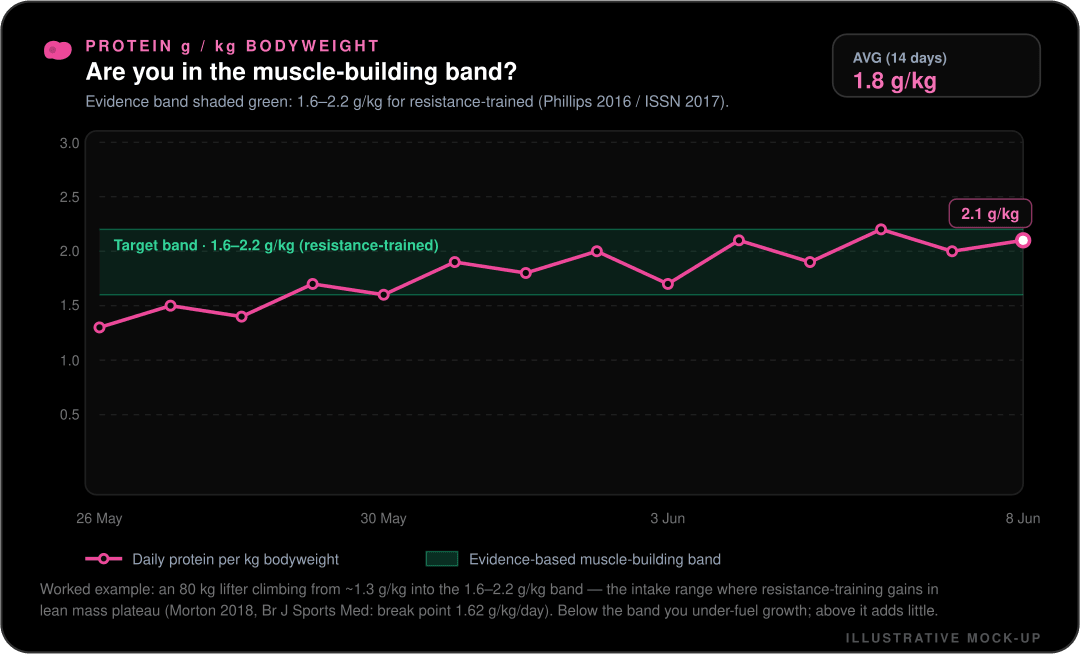
The intuitive assumption is that older, less active people need less protein. The evidence says the opposite. The standard RDA of 0.8 g/kg/day is increasingly seen as inadequate for older adults. The PROT-AGE expert group (Bauer 2013, JAMDA) recommends 1.0 to 1.2 g/kg/day for healthy older people, rising to 1.2 to 1.5 g/kg for those who are ill or recovering, and the ESPEN guidelines (Deutz 2014) reach the same conclusion. The same per-kilogram chart that a lifter uses to build muscle is the one an older adult should use to defend it.
Anabolic resistance: older muscle needs a bigger push
There is a second reason older adults need more, not less: anabolic resistance. Ageing muscle responds less strongly to a given dose of protein, so it takes a larger meal to trigger the same muscle protein synthesis. Moore and colleagues (2015) estimated that older adults need roughly 0.40 g of protein per kilogram per meal to maximally stimulate synthesis, against about 0.24 g/kg in younger adults. In practice that means aiming for around 25 to 30g of high-quality protein per meal, delivering about 2.5 to 2.8g of leucine — the same threshold that drives growth in younger lifters, just harder to reach with a small or low-quality meal.
The nuance: the protein-and-longevity debate
It would be dishonest to pretend the picture is one-sided. An influential observational study by Levine and colleagues (2014, Cell Metabolism) found that high protein intake in middle age (50 to 65) was associated with higher mortality, an effect attributed partly to the growth factor IGF-1 — yet in the same study, higher protein in those over 65 was protective, and the harmful association was driven by animal rather than plant protein. This is observational data, not proof of cause, and it sits alongside a large body of work showing muscle preservation lowers mortality risk. The sensible reading is not "avoid protein" but: favour quality protein, lean toward plant and lean-animal sources, and — crucially — pair it with resistance training, which directs amino acids toward building muscle rather than circulating growth signals.
You spend your first decades building muscle and your later ones spending it. Protein and training decide how much you have to spend.
This article is general information, not medical advice. Protein needs and the risks around them depend on individual health — particularly kidney function — so anyone with a medical condition, or over 65 considering a significant change in diet or training, should consult a clinician first.
Ready to put this into practice?
Misi BioLabs turns your bloods into a meal plan, training block and AI coaching — in one place.
Start freeFree tools
- PhenoAge Calculator — Biological age from a standard blood panel (Levine 2018).
- Biological Age Calculator — How fast are you really ageing? Nine blood markers answer it — no quiz.
- VO2max Calculator — Cooper 12-minute test → VO2max + fitness age + mortality hazard.