2 min readDaily Habits & Protocol Stacks
Sauna and cold — the evidence, and what your readiness score shows
Sauna has surprisingly strong longevity data; cold plunges are buzzier but more mixed — and timing one wrong can cost you gains. Here is what holds up, and how Misi tracks the effect on recovery.
Part 15 of 23This article is part of the Daily Habits & Protocol Stacks guideHeat and cold have become the rituals of the wellness world, complete with bold claims in both directions. The evidence is real but uneven: sauna has some genuinely impressive longevity data behind it, while cold exposure is buzzier than it is proven — and getting the timing wrong can actually blunt your training. It is worth separating what holds up from what is hype.
The sauna evidence is surprisingly strong
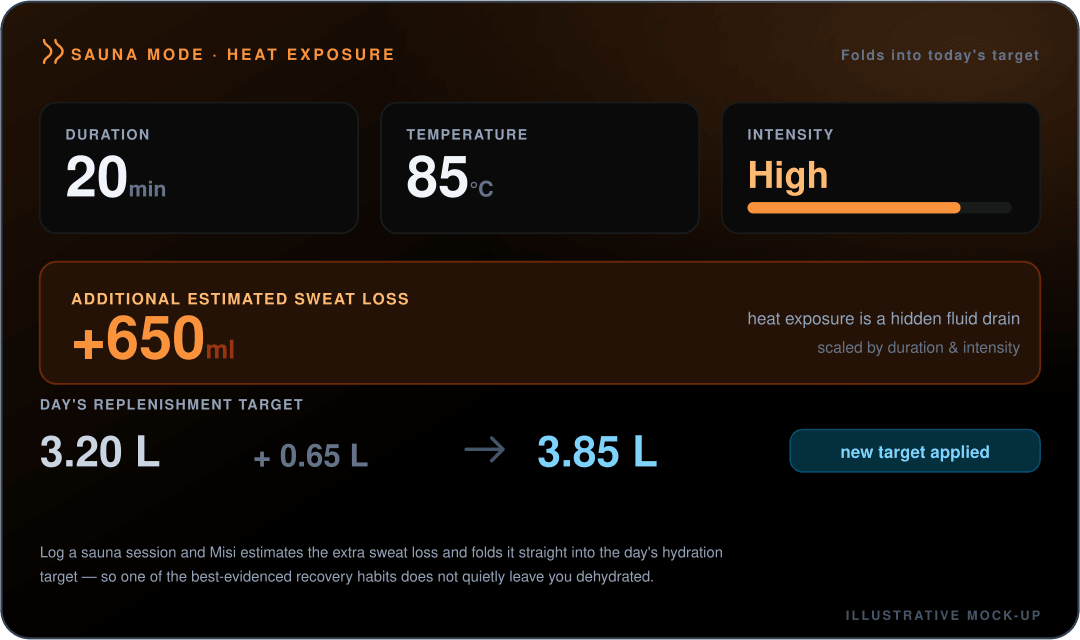
The standout finding comes from a long-running Finnish cohort (Laukkanen 2015, JAMA Internal Medicine). Compared with men who used a sauna once a week, those who used one four to seven times a week had roughly 40% lower all-cause mortality, along with lower rates of cardiovascular and sudden cardiac death, in a dose-dependent pattern. It is observational data, so it cannot prove cause alone — but the size and consistency of the effect, plus plausible mechanisms like improved vascular function and heat-shock protein activation, make it one of the more compelling recovery-and-longevity signals out there.
Cold is more mixed than the hype suggests
Cold-water immersion has enthusiastic advocates and some support for short-term recovery, mood and alertness, but the long-term health evidence is far thinner than sauna’s. And there is a specific catch for anyone trying to build muscle: immersing in cold water straight after resistance training can blunt the muscle-building and strength adaptations you just worked for (Roberts 2015, Journal of Physiology). The cold suppresses the very inflammatory signalling that drives the gains.
Timing is the whole game
The practical rule that falls out of this: do not cold-plunge straight after a hypertrophy or strength session if growth is your goal — save it for rest days, or separate it by several hours. Heat is more forgiving and can sit comfortably alongside training. Used well, both are recovery tools; used at the wrong moment, cold quietly works against the training it is meant to support.
How Misi tracks the effect
Recovery tools are only worth it if they actually improve your recovery, and that is measurable. Misi’s daily readiness score combines several signals into one number each morning, and the CNS tap test gives an objective read on nervous-system recovery. Log your sauna and cold sessions and you can see whether they move your readiness in the right direction over time — turning a fashionable ritual into something you can confirm is working for you, not against you.
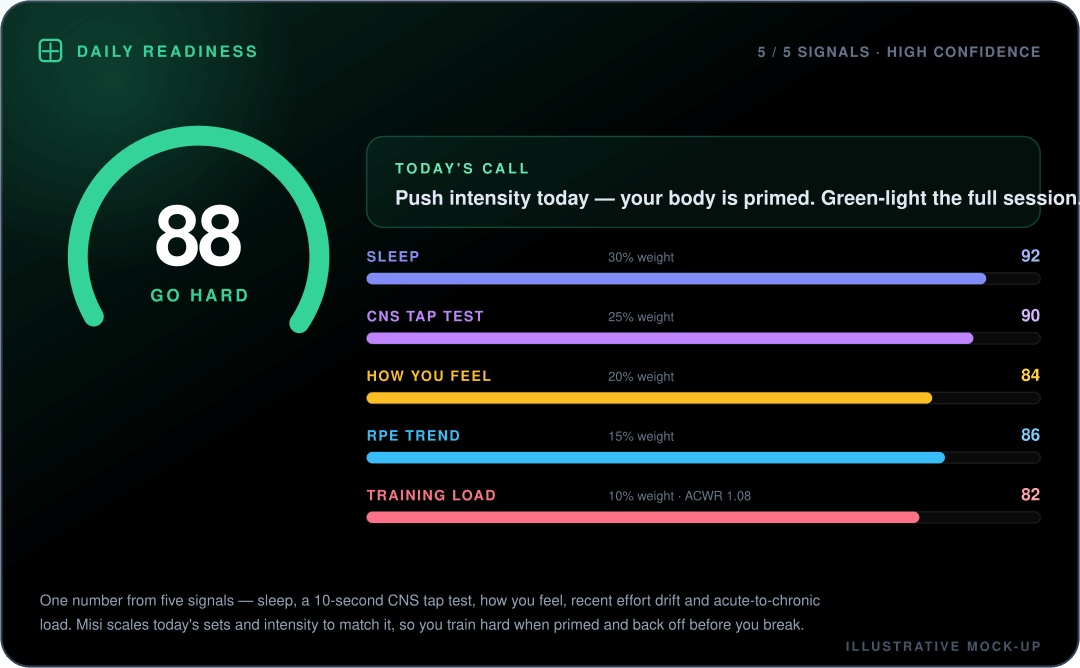
Sauna has the longevity data; cold has the timing trap. Use the heat freely, save the cold for rest days — and let your readiness score tell you if either is working.
This is general information, not medical advice. Heat and cold exposure place real stress on the cardiovascular system — anyone with heart disease, blood-pressure problems, or who is pregnant should consult a clinician before using saunas or cold immersion.
Ready to put this into practice?
Misi BioLabs turns your bloods into a meal plan, training block and AI coaching — in one place.
Start freeFree tools
- PhenoAge Calculator — Biological age from a standard blood panel (Levine 2018).
- Biological Age Calculator — How fast are you really ageing? Nine blood markers answer it — no quiz.
- VO2max Calculator — Cooper 12-minute test → VO2max + fitness age + mortality hazard.