3 min readTraining & Programming
How much training actually builds muscle — counting sets per muscle
Hypertrophy is dose-dependent, and the dose is weekly sets per muscle — not how hard a session felt. Misi counts it for you, splits direct and indirect work, and plots each muscle against its evidence-based target band.
Part 2 of 38This article is part of the Training & Programming guideFor all the noise about the perfect split or the magic rep range, the single most validated driver of muscle growth is unglamorous: how many hard sets you give each muscle each week. Get that dose right, repeatedly, and you grow. Most people have no idea what their number actually is — they feel busy in the gym and assume that is the same thing.
Sets per muscle is the dose that matters
The clearest signal in the hypertrophy literature is a dose-response relationship between weekly sets per muscle group and growth. Schoenfeld, Ogborn and Krieger's 2017 meta-analysis found muscle gain rising with weekly set volume, and a broadly useful working range emerged: roughly 10 to 20 hard sets per week for a major muscle. Below that you are under-stimulating; far above it you are mostly buying fatigue and injury risk, not extra growth.
Why you cannot just count sets in your head
The complication is that exercises do not train one muscle. A bench press is obviously chest work — but it also loads the shoulders and triceps. If you count it only as chest, you under-count your triceps; if you count it fully for all three, you wildly over-count. This is exactly why honest volume tracking is tedious to do by hand, and why most people simply do not.
Direct 1.0, indirect 0.5 — fractional counting
Misi uses the fractional set-counting convention that evidence-based coaches have settled on. A muscle worked as the prime mover earns a full set (1.0); a muscle working as a synergist earns half a set (0.5). So one set of bench press credits 1.0 to chest, 0.5 to shoulders and 0.5 to triceps. Every logged set is split this way using each exercise's primary and secondary muscles from the exercise library, then summed across the week.
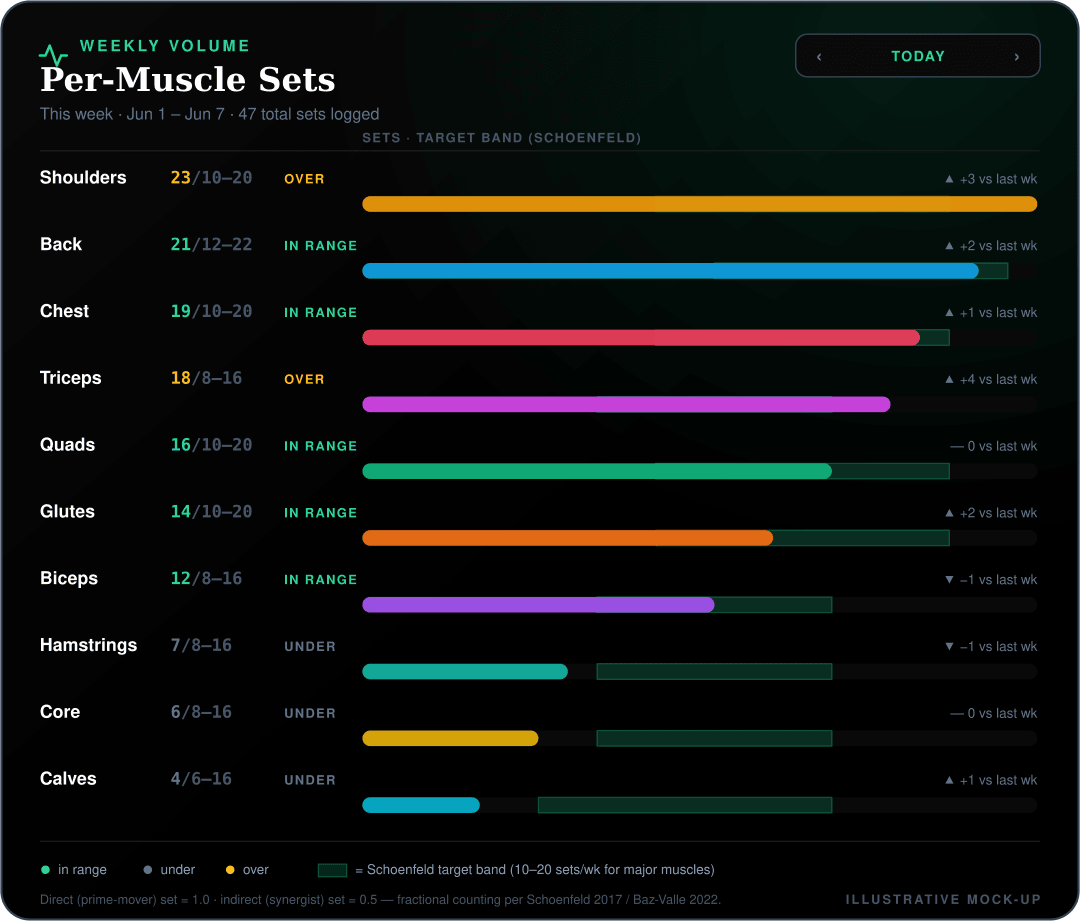
The picture most lifters never see
Plot every muscle against its own target band and imbalances jump out instantly. The example above is the classic upper-body-pressing trainee: shoulders and triceps run over their bands purely from the indirect volume of all that pushing, while hamstrings, core and calves quietly sit under-stimulated. No amount of "training hard" fixes that — only redistributing sets does. The smaller muscles, biceps, triceps and calves, sit on lower bands precisely because they soak up so much indirect work from compound lifts.
From diagnosis to the next session
A target band is only useful if it changes what you do next. Because the same engine writes your programme, Misi can flag a muscle drifting below its band for a fortnight and nudge volume toward it, while easing off a muscle that has crept over. The aim is not to chase the top of every band — it is to keep each muscle in its effective range without burying yourself in junk volume.
You do not grow because a session felt brutal. You grow because the right muscle got the right number of hard sets, week after week.
Target ranges are population guidelines, not personal prescriptions — training age, recovery and individual response all shift your true optimum. Build up to higher volumes gradually.
Ready to put this into practice?
Misi BioLabs turns your bloods into a meal plan, training block and AI coaching — in one place.
Start freeFree tools
- PhenoAge Calculator — Biological age from a standard blood panel (Levine 2018).
- Biological Age Calculator — How fast are you really ageing? Nine blood markers answer it — no quiz.
- VO2max Calculator — Cooper 12-minute test → VO2max + fitness age + mortality hazard.