2 min readBlood Biomarkers
Glucose spikes and the CGM hype — what your fasting markers really tell you
Continuous glucose monitors have gone mainstream for people without diabetes. Here is what the spikes do and do not mean — and the validated markers that tell you more.
Part 9 of 26This article is part of the Blood Biomarkers guideContinuous glucose monitors (CGMs) were built for people with diabetes, but they have become a wellness phenomenon for everyone else — strap one on, watch your glucose spike after toast, and conclude something is wrong. Some of that is genuinely useful self-knowledge. Some of it is over-interpretation of a number that, in a healthy person, is supposed to move.
Spiking is normal — that is the system working
When you eat carbohydrate, your blood glucose rises and your body releases insulin to bring it back down. In a metabolically healthy person that is the system functioning exactly as designed. A post-meal rise is not damage; it is digestion. The evidence that short glucose excursions in non-diabetics independently cause disease is still limited and emerging — far weaker than the marketing around CGMs often implies.
Responses are personal
What CGMs did usefully reveal is that people respond very differently to the same food. The landmark work of Zeevi and colleagues (2015, Cell) and later the PREDICT studies (Berry 2020) showed that an identical meal can spike one person and barely move another, shaped by the microbiome, sleep, activity and genetics. That personalisation is real and interesting — but it is a reason to learn your own patterns, not to fear every rise on a graph.
The markers that actually matter
For assessing your metabolic health, validated blood markers tell you more than a fortnight of squiggly CGM lines. Fasting glucose, HbA1c (your average glucose over about three months), and insulin-based indices like HOMA-IR and the TyG index reveal whether your system is genuinely struggling to manage glucose — the thing that predicts diabetes and cardiovascular risk. These are the numbers worth tracking over time.
How Misi keeps it in proportion
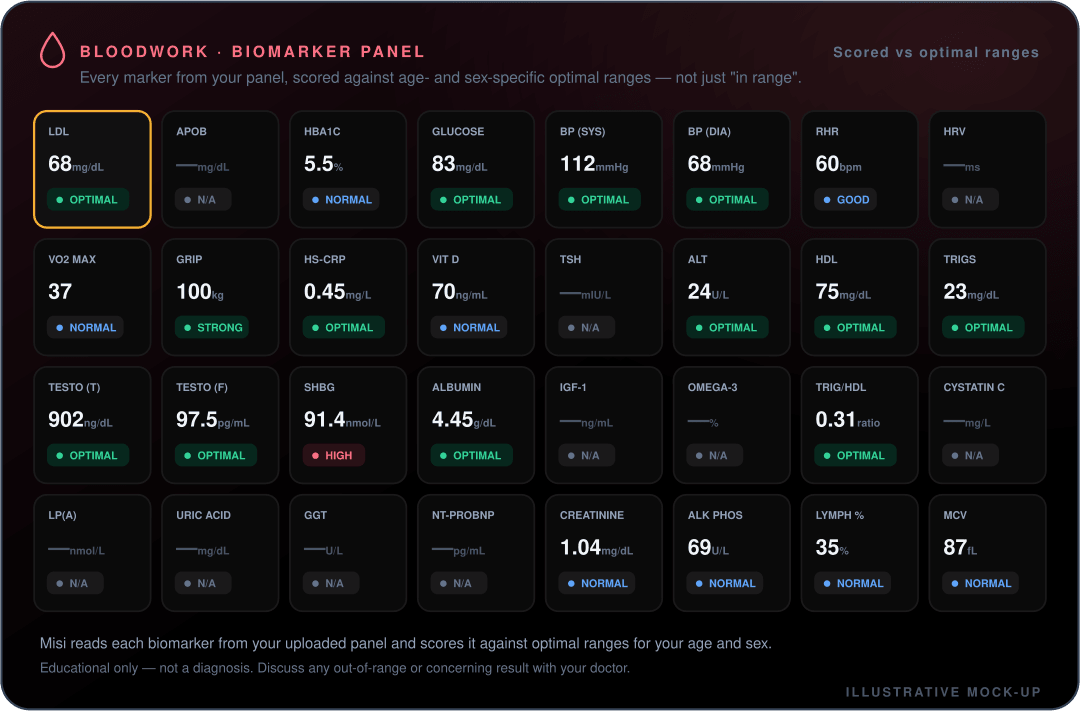
Misi computes your insulin-resistance markers from a standard blood panel and tracks them over time, alongside your nutrition and training. If you do use a CGM, that context is what turns the data into something meaningful: a recurring high fasting glucose or rising HOMA-IR is a signal worth acting on, whereas a single spike after a bowl of rice usually is not. The "meals that fit your bloodwork" feature then steers your plan using the markers that are actually predictive.
A glucose spike after a meal is usually your metabolism working, not failing. Your fasting glucose, HbA1c and insulin markers tell you far more than any single squiggle.
This is general information, not medical advice. If you are worried about your blood sugar or metabolic health, ask your doctor for fasting glucose and HbA1c testing and interpret the results with them.
Ready to put this into practice?
Misi BioLabs turns your bloods into a meal plan, training block and AI coaching — in one place.
Start freeFree tools
- PhenoAge Calculator — Biological age from a standard blood panel (Levine 2018).
- Biological Age Calculator — How fast are you really ageing? Nine blood markers answer it — no quiz.
- VO2max Calculator — Cooper 12-minute test → VO2max + fitness age + mortality hazard.