2 min readNutrition & Diet Analytics
Ultra-processed food — why a curated database sidesteps the problem
The strongest evidence against ultra-processed food is not a scare story — it is a metabolic-ward experiment. Here is what it showed, the honest nuance, and why a whole-food meal database is a structural answer.
Part 45 of 51This article is part of the Nutrition & Diet Analytics guideUltra-processed food (UPF) is the most heated topic in nutrition right now, and the debate often generates more heat than light. Stripped of the noise, there is a genuinely strong piece of evidence, an important nuance, and a practical takeaway that does not require you to become a label detective.
What "ultra-processed" means
The term comes from the NOVA classification, which sorts foods by how much industrial processing they have undergone rather than by their nutrients. Ultra-processed foods are industrial formulations — often containing ingredients and additives you would not find in a home kitchen — engineered for convenience, long shelf life and what the industry calls hyper-palatability. Think mass-produced snacks, sugary drinks, reconstituted meats and many ready meals.
The experiment that changed the conversation
Most nutrition evidence is observational, which means it can show association but not cause. UPF has something rarer. Hall and colleagues (2019) ran a tightly controlled metabolic-ward study where participants ate either an ultra-processed or an unprocessed diet, matched for calories, sugar, fat, fibre and macronutrients, and were free to eat as much as they wanted. On the ultra-processed diet people ate about 500 calories more per day and gained weight; on the unprocessed diet they ate less and lost it. Same nutrients on paper — very different outcomes. That is about as close to causal evidence as nutrition gets.
The honest nuance
UPF is a broad category, and not everything in it is equally harmful — wholegrain bread and a sugary soft drink are not the same thing despite both being "processed." Large observational studies (Pagliai 2021) link high UPF intake to higher rates of obesity, cardiovascular disease and mortality, but observational data carries the usual caveats. The sensible reading is not panic, but pattern: the more of your diet that comes from whole and minimally processed foods, the better the evidence looks.
Why a curated database is a structural fix
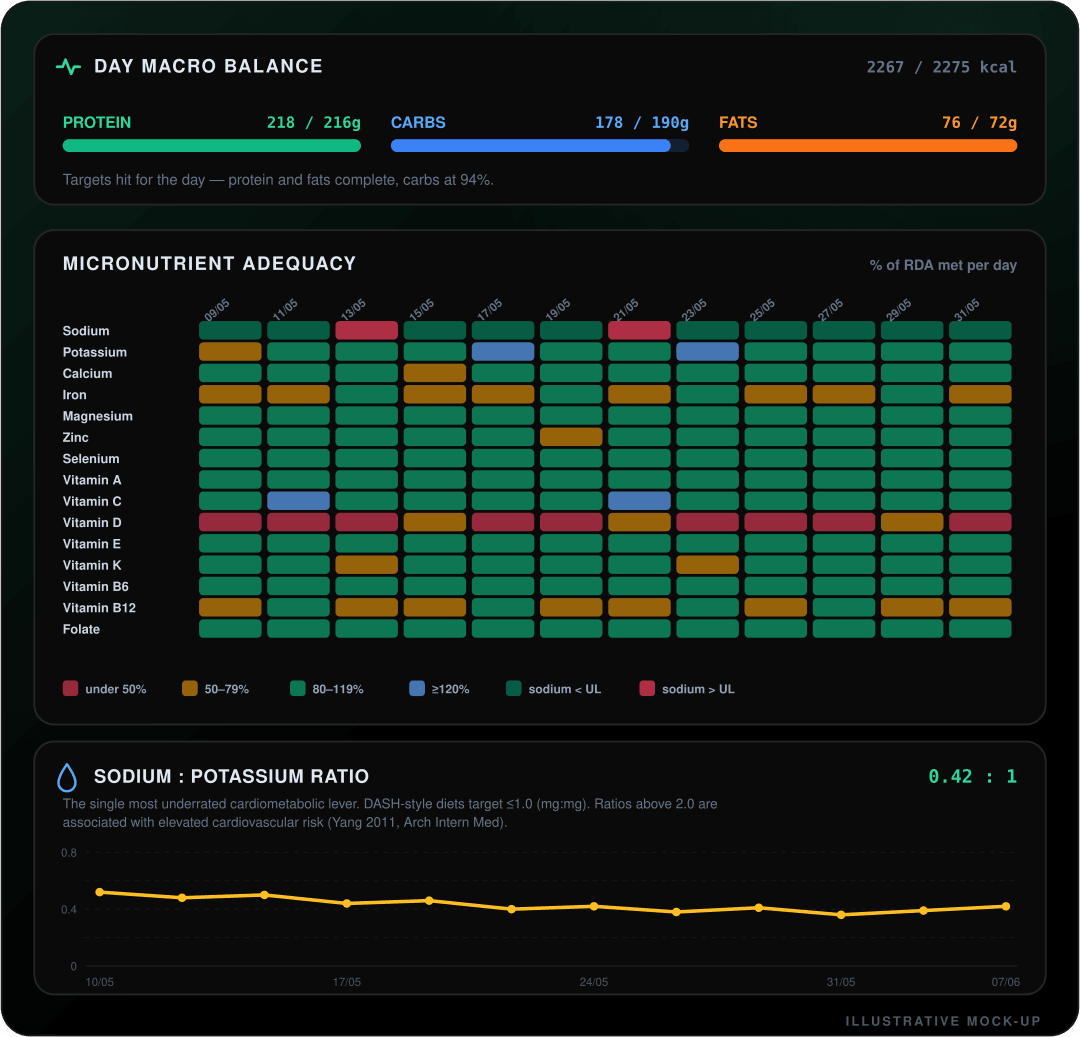
Avoiding UPF through willpower and label-reading is exhausting and easy to abandon. Misi takes a structural approach instead: your meal plans are assembled from a precision-curated, lab-checked database of real, whole-food meals, so the default is minimally processed rather than something you have to police. The food analyser and micronutrient tracking then show you the quality of what you are eating, not just the calorie count — turning "eat less processed food" from a vague aspiration into the path of least resistance.
The most reliable way to eat less ultra-processed food is not more willpower — it is changing the default so the easy choice is already a whole-food one.
This is general nutrition information, not medical advice. Individual needs vary; anyone managing a medical condition should work with a clinician or dietitian on dietary changes.
Ready to put this into practice?
Misi BioLabs turns your bloods into a meal plan, training block and AI coaching — in one place.
Start freeFree tools
- PhenoAge Calculator — Biological age from a standard blood panel (Levine 2018).
- Biological Age Calculator — How fast are you really ageing? Nine blood markers answer it — no quiz.
- VO2max Calculator — Cooper 12-minute test → VO2max + fitness age + mortality hazard.