2 min readDaily Habits & Protocol Stacks
Hydration done properly: training days, rest days, fasting — and sauna
Most people treat hydration as one flat number. Your body does not. Here is how fluid needs shift across training, rest, fasting and heat exposure — and how Misi calculates each.
Part 5 of 23This article is part of the Daily Habits & Protocol Stacks guideHydration is the easiest performance lever to get wrong. A 2% drop in body water measurably impairs strength, endurance and concentration, yet most apps reduce the whole topic to a static "eight glasses a day". The truth is your fluid needs swing widely depending on what the day asks of you.
Training days are not rest days
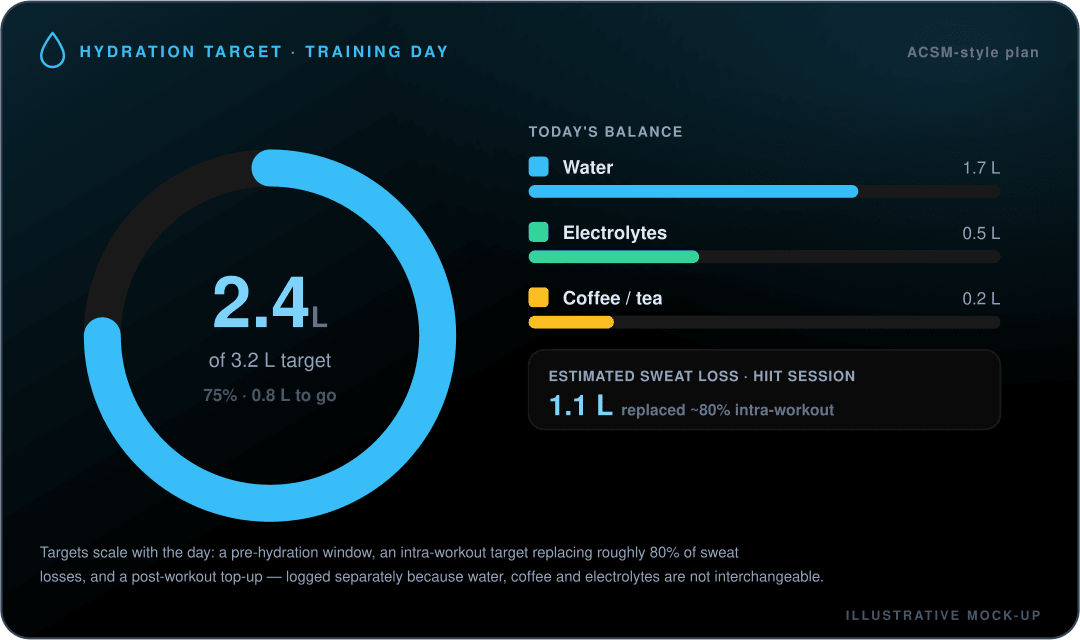
On a training day you lose fluid through sweat at a rate that depends on intensity and bodyweight. Misi estimates sweat loss per session — higher for endurance and HIIT, moderate for resistance work, lower for mobility — and builds an ACSM-style plan around it: a pre-hydration window, an intra-workout target to replace roughly 80% of losses without gastric distress, and a post-workout top-up to clear the remaining deficit.
Rest and active-recovery days
Lower output does not mean you stop drinking. Misi keeps a sensible baseline on rest and active-recovery days, adjusting for any heat exposure rather than carrying a full training-day target you do not need. It is the difference between hydrating for the day you are actually having and over- or under-shooting on autopilot.
Fasting days
When you are fasting you lose the water that normally comes from food, so Misi raises the baseline, leans the target toward electrolytes, and still accounts for any coffee or tea — helping you stay clear-headed through the fast instead of foggy and cramping.
Sauna mode
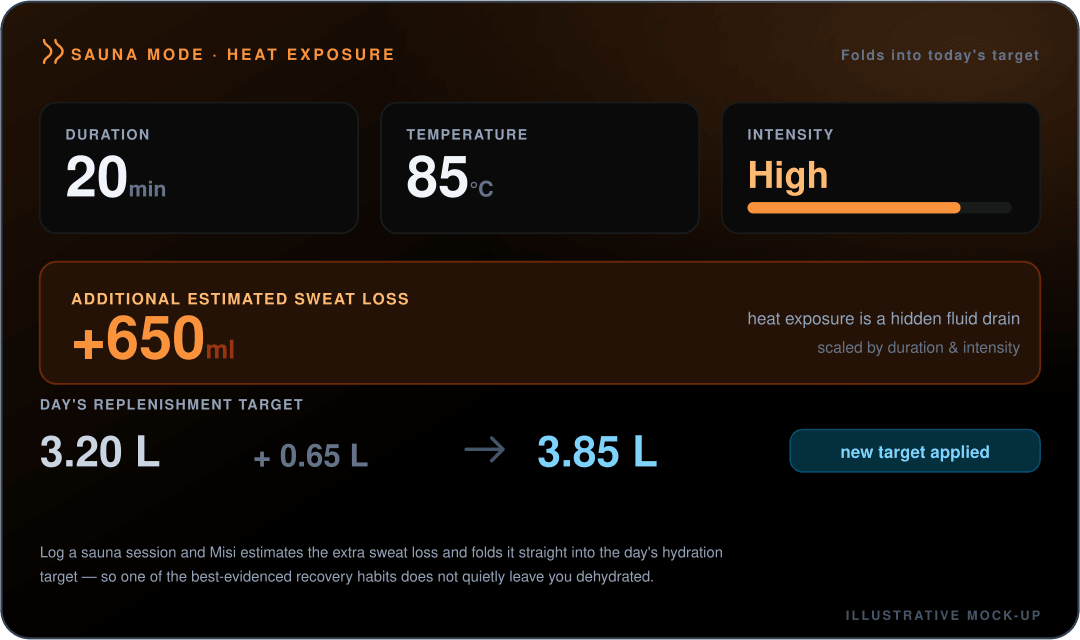
Heat exposure is one of the most evidence-backed recovery and longevity habits — but it is also a hidden fluid drain. Misi's sauna mode lets you log duration and intensity, estimates the additional sweat loss in millilitres, and folds it straight into the day's replenishment target so a post-session sauna does not quietly leave you dehydrated.
Logging that matches reality
You log water, coffee and electrolytes separately, because they are not interchangeable. Misi tracks each against the day's adjusted target and shows the running balance, so the number you are chasing always reflects your training, your fasting and your heat exposure — not a one-size-fits-all guess.
Hydrate for the day you are actually having. The right target on a sauna day is not the right target on a rest day.
Ready to put this into practice?
Misi BioLabs turns your bloods into a meal plan, training block and AI coaching — in one place.
Start freeFree tools
- PhenoAge Calculator — Biological age from a standard blood panel (Levine 2018).
- Biological Age Calculator — How fast are you really ageing? Nine blood markers answer it — no quiz.
- VO2max Calculator — Cooper 12-minute test → VO2max + fitness age + mortality hazard.