2 min readLongevity & Biological Age
Strength is a vital sign — why your 1RM tracks your lifespan
Muscular strength is one of the most powerful predictors of how long you will live — rivalling blood pressure and smoking. Here is the evidence, and why Misi treats your strength as a longevity metric.
Part 8 of 23This article is part of the Longevity & Biological Age guideWe are used to thinking of strength as something for athletes or the aesthetically motivated. The longevity data reframes it entirely: muscular strength is one of the most powerful predictors of all-cause mortality we have, strong enough that some researchers argue it should be measured in the clinic like blood pressure. How much you can lift is, in a real sense, a vital sign.
The grip-strength evidence
The clearest data comes from grip strength, a cheap proxy for whole-body strength. In the PURE study (Leong 2015, The Lancet), spanning around 140,000 people across 17 countries, each 5 kg reduction in grip strength was associated with a 16% higher risk of all-cause mortality — and grip strength predicted death more strongly than systolic blood pressure. The UK Biobank analysis (Celis-Morales 2018, BMJ) reached the same conclusion across half a million people: lower strength tracked higher mortality, cardiovascular disease and cancer.
Why strength predicts survival
Strength is a readout of how much functional muscle you carry and how well your nervous system drives it — and muscle is metabolic reserve, glucose disposal, fall protection and resilience when illness strikes. A meta-analysis by Volaklis and colleagues (2015) confirmed that higher muscular strength is associated with significantly lower mortality across populations. Strength is not just correlated with health; it reflects the very tissue and function that keep you alive and independent.
A number you can actually change
Unlike your chronological age, strength responds to training at any age — including in your seventies and eighties, where resistance training reliably rebuilds it. That is what makes it such a useful target: it is a powerful predictor of lifespan that also sits directly under your control. Building strength is one of the few interventions that improves how long you live and how well you live at the same time.
How Misi treats strength as longevity
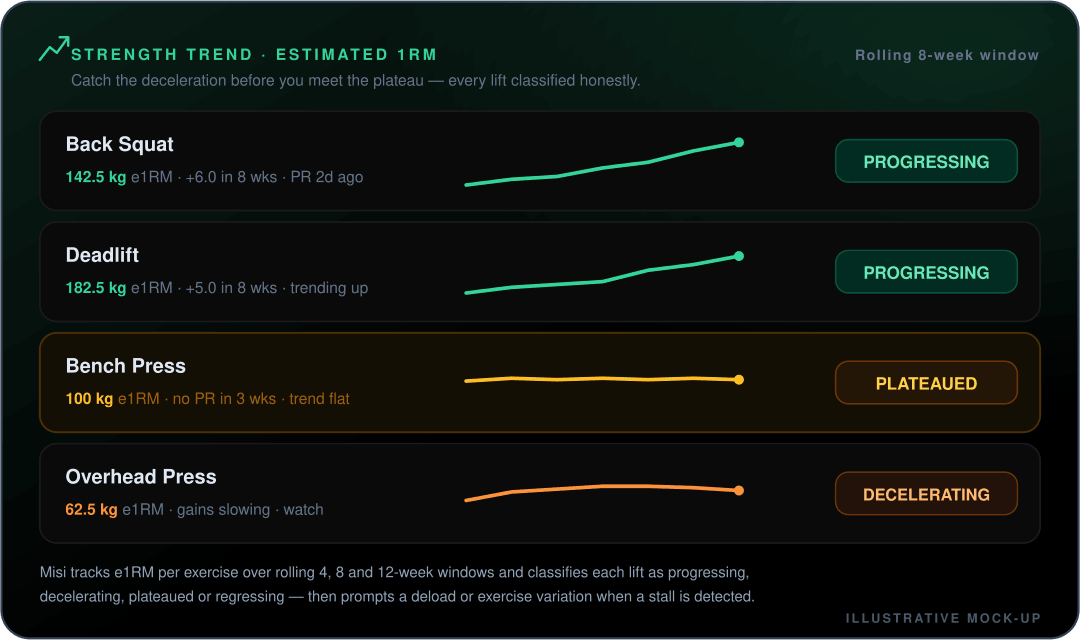
Misi estimates your one-rep-max from your logged sets and charts it over time, so your strength becomes a metric you watch like any other health marker. It then folds into the bigger picture: the composite longevity score combines your strength, cardiorespiratory fitness and biomarkers into a single view of how your body is actually ageing — with strength given the weight the evidence says it deserves.
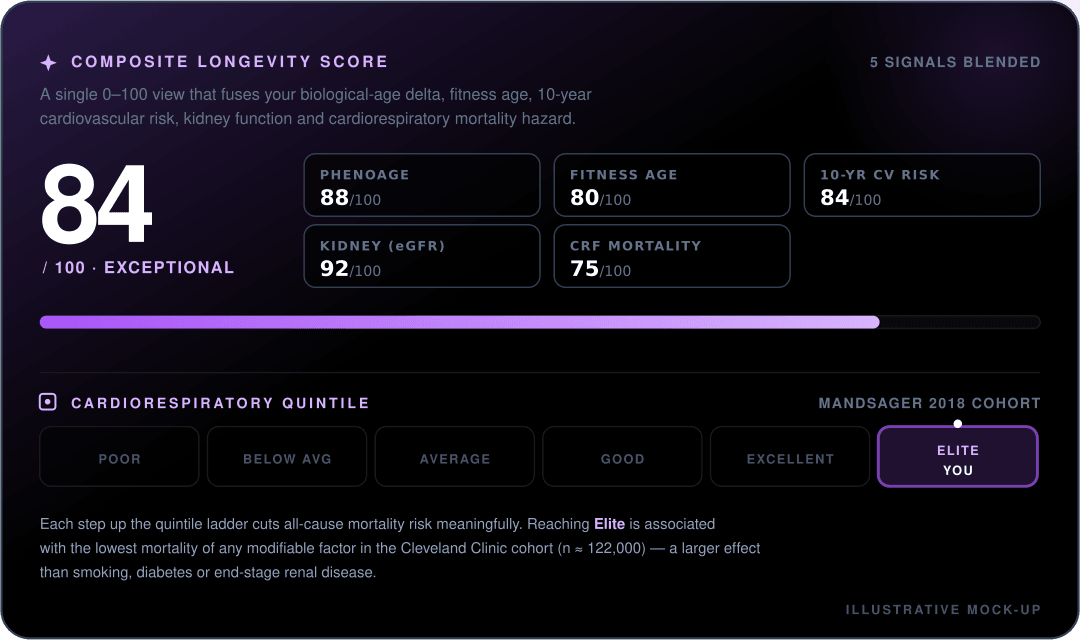
Your one-rep-max is not vanity. Tracked over the years it is one of the best predictors of your lifespan you can measure — and one of the few you can train upward.
This is general information, not medical advice. Anyone new to resistance training, older, or with a medical condition should get guidance on safe technique and clearance from a clinician before lifting heavy.
Ready to put this into practice?
Misi BioLabs turns your bloods into a meal plan, training block and AI coaching — in one place.
Start freeFree tools
- PhenoAge Calculator — Biological age from a standard blood panel (Levine 2018).
- Biological Age Calculator — How fast are you really ageing? Nine blood markers answer it — no quiz.
- VO2max Calculator — Cooper 12-minute test → VO2max + fitness age + mortality hazard.