3 min readBlood Biomarkers
Ferritin low but iron "normal"? Why you’re flat in the gym
Your iron came back "normal," yet you’re exhausted and your training has stalled. The marker your doctor may not have flagged is ferritin — and it can be depleted long before anaemia shows up.
Part 7 of 26This article is part of the Blood Biomarkers guideYou feel flat. Warm-ups feel like working sets, your usual runs leave you wrecked, and progress has quietly stopped. You ask for a blood test, the iron comes back "normal," and you are sent away none the wiser. The problem is that "iron normal" and "iron stores adequate" are not the same thing — and the marker that tells them apart, ferritin, is the one most likely to have been overlooked.
Ferritin empties before anaemia appears
Ferritin is your stored iron — the reserve tank. Your body will protect the iron circulating in your blood (and therefore your haemoglobin) by drawing down that reserve first. So you can have low ferritin, an empty tank, while your haemoglobin and serum iron still read "normal." This is iron deficiency without anaemia, and it is genuinely common in endurance athletes and menstruating women. The fatigue and poor performance arrive long before the classic anaemia flag your doctor is watching for.
Why low ferritin flattens your training
Iron sits at the centre of oxygen transport and energy metabolism. Deplete the stores and oxygen delivery to working muscle drops, aerobic capacity falls, and recovery drags — a picture that reads almost identically to overtraining. That is precisely why it gets misdiagnosed: the athlete adds rest or backs off volume when the real fix is refilling the tank. Studies in athletes suggest ferritin below roughly 30 to 40 ng/mL is where performance and energy commonly suffer, well above the ~15 ng/mL threshold used to define frank deficiency.
How to refill the tank
Food first: haem iron from red meat, poultry and fish is far better absorbed than the non-haem iron in plants, and pairing plant sources (lentils, spinach, fortified grains) with vitamin C improves uptake. Tea, coffee and calcium taken with a meal blunt absorption, so separate them from your iron-rich meals. Where diet is not enough — often the case for heavy menstruators or vegetarians in deficit — a supervised iron supplement restores stores over weeks to months, but supplementing blind is a mistake because too much iron is harmful. This is a marker to confirm and monitor, not guess at.
How Misi connects the dots
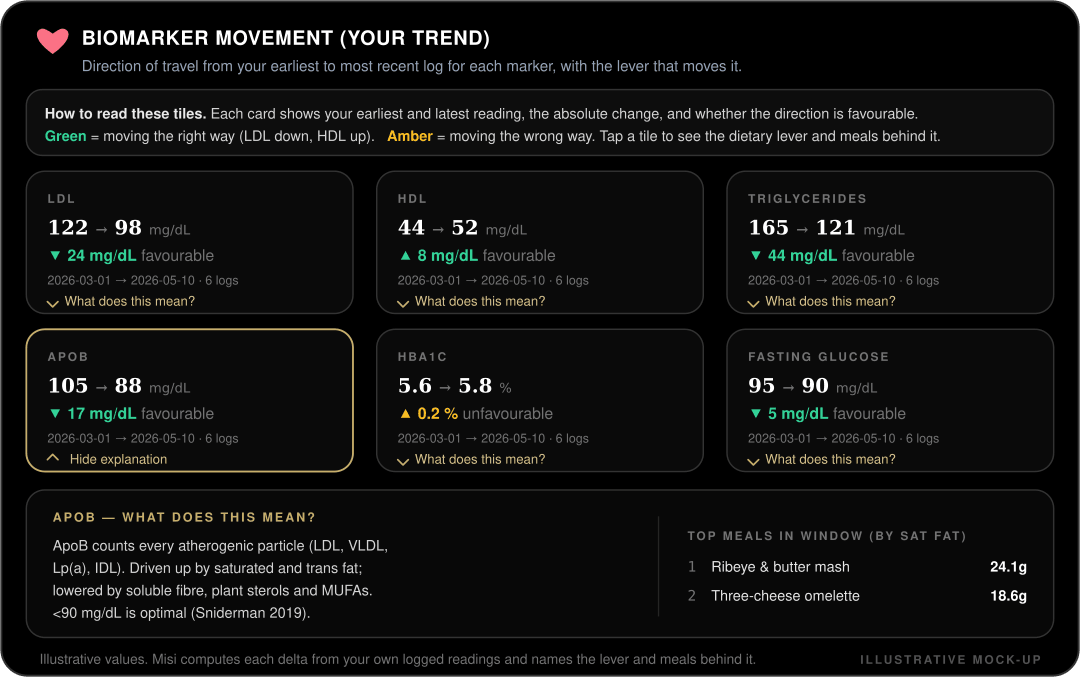
Misi parses ferritin and the full iron panel from your labs and tracks them against your training load and readiness, so a run of flat sessions can be checked against your stores rather than blamed on willpower or written off as overtraining. When the data points at depleted iron, you have something concrete to take to your doctor — and a trend to watch as the tank refills. Our companion piece on iron and hormones covers the wider fatigue picture.
"Iron normal" can hide an empty tank. Ferritin is the reserve gauge — and in the gym, it often reads empty long before your doctor’s anaemia flag ever trips.
This is general information, not medical advice. Both low and high iron carry health risks, and iron supplements should only be taken to correct a confirmed deficiency under medical guidance. Ask your doctor to test ferritin specifically, and interpret the result with them.
Ready to put this into practice?
Misi BioLabs turns your bloods into a meal plan, training block and AI coaching — in one place.
Start freeFree tools
- PhenoAge Calculator — Biological age from a standard blood panel (Levine 2018).
- Biological Age Calculator — How fast are you really ageing? Nine blood markers answer it — no quiz.
- VO2max Calculator — Cooper 12-minute test → VO2max + fitness age + mortality hazard.