2 min readInside Misi
Your daily readiness score: five signals, one number, before you lift
Sleep, a CNS tap test, how you feel, your RPE trend and recent training load each tell you something about recovery. Misi fuses them into one readiness score so you know how hard to go today.
Part 6 of 9This article is part of the Inside Misi guidePlenty of apps track recovery signals. Almost none of them tell you what to actually do with the pile of numbers. A readiness score is only useful if it collapses everything you know about how recovered you are into a single, honest verdict — and then changes the session in front of you.
One score from five signals
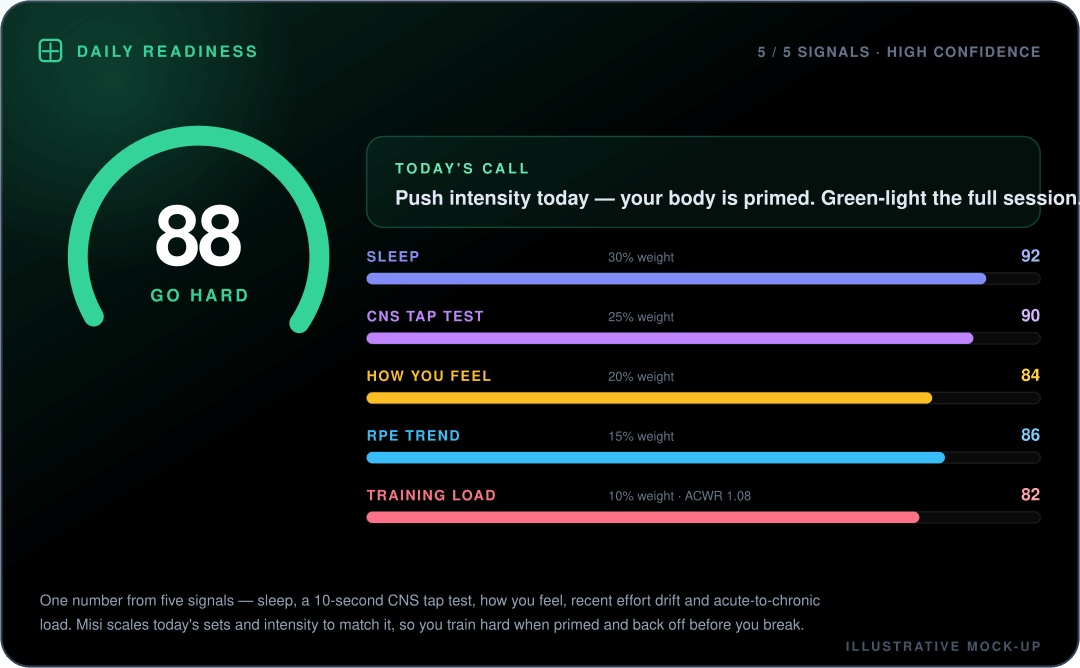
Misi builds your daily readiness score from five inputs: how you slept, the CNS tap test, a quick subjective “how you feel” rating, your recent RPE trend, and accumulated training load. Each is scored and weighted, then combined into one number on a sweep gauge with a clear band — go hard, proceed, or back off.
Why one number, not five dashboards
Five separate readouts force you to do the integration in your head every morning — and most people either over-react to one bad signal or ignore all of them. A single score with a visible breakdown gives you the verdict at a glance, while still letting you see why: if sleep tanked the number, the sleep bar shows it.
The CNS tap test does the heavy lifting
Subjective inputs drift — people talk themselves into feeling fine. The CNS tap test is the hardest signal to fake, because tapping speed reflects nervous-system fatigue you cannot will away. It is the objective anchor among the five, and it is worth understanding on its own; we cover what it is and how it auto-regulates your training in a dedicated piece.
The point of a readiness score is not to admire it. It is to know, before your first set, whether today is a push day or a hold day.
Readiness scores are training tools, not medical assessments. Persistent low readiness alongside poor sleep, low mood or unusual fatigue is a reason to rest and, if it continues, to consult a qualified clinician.
Ready to put this into practice?
Misi BioLabs turns your bloods into a meal plan, training block and AI coaching — in one place.
Start freeFree tools
- PhenoAge Calculator — Biological age from a standard blood panel (Levine 2018).
- Biological Age Calculator — How fast are you really ageing? Nine blood markers answer it — no quiz.
- VO2max Calculator — Cooper 12-minute test → VO2max + fitness age + mortality hazard.