1 min readLongevity & Biological Age
"Am I aging faster than the calendar?" Your Fitness Age Trajectory
Two people the same age can have bodies a decade apart in function. Misi turns your fitness data into a Fitness Age — and, more importantly, shows which direction it is moving.
Part 7 of 23This article is part of the Longevity & Biological Age guideChronological age moves at exactly one year per year for everyone. Biological function does not. The interesting question is not how old you are, but whether the gap between your calendar age and your functional age is widening or closing.
What Fitness Age means
Fitness Age translates your cardiorespiratory fitness and related markers into the age at which your numbers would be average. A 45-year-old with a strong VO2max might carry a fitness age of 35 — a decade of functional headroom.
The trajectory is the point
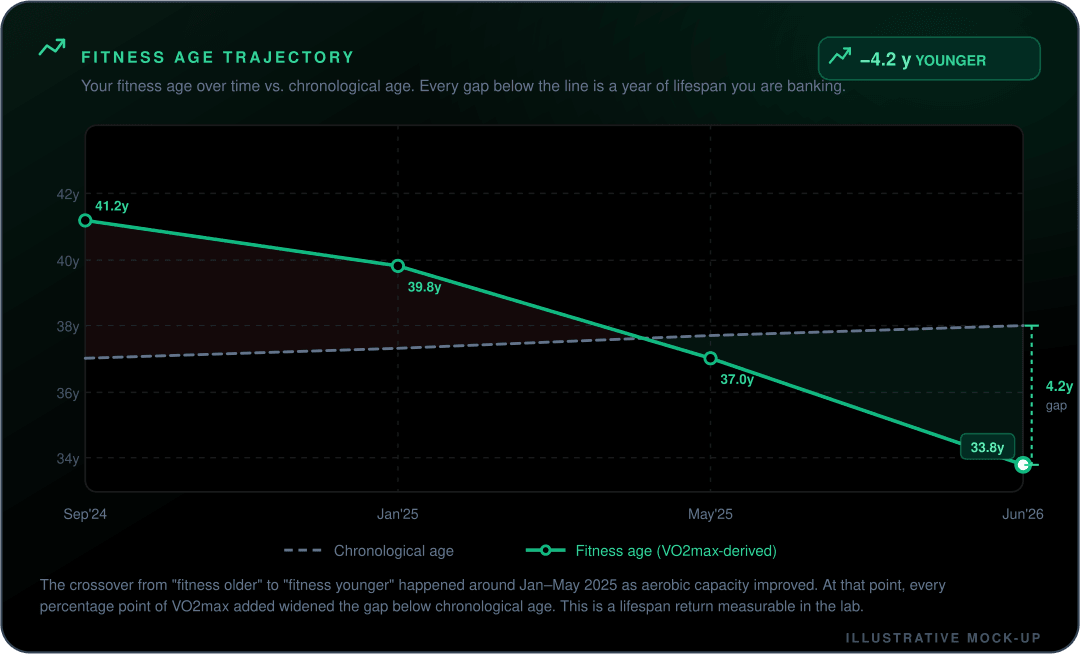
A single fitness-age reading is interesting; the trajectory is decisive. Misi plots yours over time so you can see whether your training is buying back years or whether a busy season is quietly costing them.
Tied to the work that moves it
Because the same engine programmes your training, the cardio and interval work that improves fitness age is built into your plan — and the trajectory shows the return on it.
You cannot stop the calendar. You can absolutely change the slope of your fitness age.
Ready to put this into practice?
Misi BioLabs turns your bloods into a meal plan, training block and AI coaching — in one place.
Start freeFree tools
- PhenoAge Calculator — Biological age from a standard blood panel (Levine 2018).
- Biological Age Calculator — How fast are you really ageing? Nine blood markers answer it — no quiz.
- VO2max Calculator — Cooper 12-minute test → VO2max + fitness age + mortality hazard.