2 min readInside Misi
Auto-regulation: how a 10-second tap test rewrites today’s workout
Training the same volume on three hours of sleep as on nine is how people get hurt and stall. A quick tap test reads your central nervous system each morning, and Misi scales the session before you start.
Part 7 of 9This article is part of the Inside Misi guideFixed programmes assume every day is the same. Your nervous system disagrees. After bad sleep, travel or a stressful week, the same prescribed volume that built muscle last Tuesday can dig you into a hole today. The hard part has always been measuring that in the thirty seconds before you start lifting.
What the CNS tap test measures
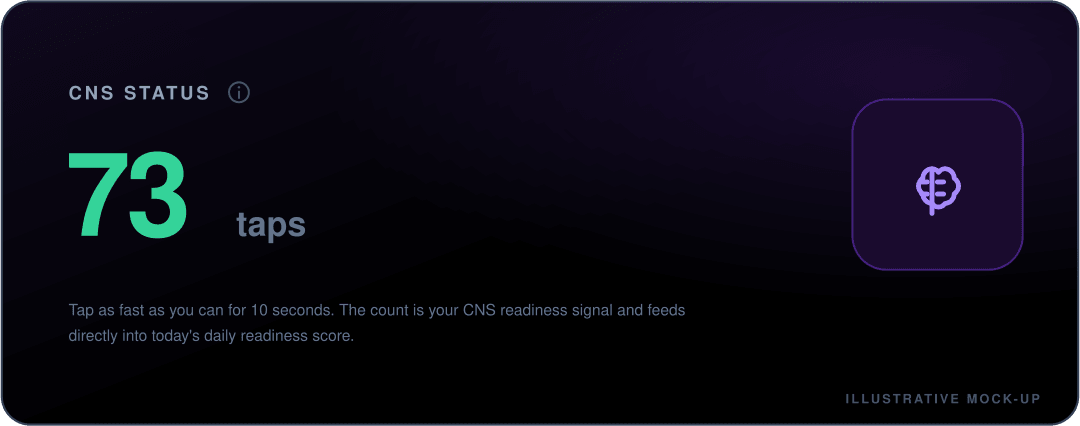
The test is exactly what it sounds like: tap a target as fast as you can for ten seconds. Tapping speed is a simple, repeatable proxy for central nervous system drive — when you are fatigued, under-slept or stressed, your reaction speed and motor output drop measurably, and the tap count falls with them. It is the same principle behind reaction-time and finger-tapping tests used in fatigue research, compressed into a ten-second check you can do anywhere.
How it rewrites today’s session
A tap score only matters if it changes the workout. On a low-reading day, Misi automatically trims working sets or caps intensity so you still train productively without overreaching. On a high-reading day, it green-lights the full session — or a little more. You are not guessing whether you are recovered; the session in front of you has already been adjusted.
It also feeds your daily readiness score
The tap test is not the whole picture — it is one input. Misi blends it with your logged sleep, how you feel, your recent RPE trend and accumulated training load into a single daily readiness score. The tap test is the hardest of those signals to fool, which is why it carries real weight in that calculation. We break down how the full readiness score is built in a separate piece.
Auto-regulation is not an excuse to train less. It is how you train hard for years instead of months.
The effect compounds: fewer missed weeks to injury or burnout means more total productive training over a year. The tap test is a proxy for readiness, not a medical diagnostic — if your scores crater for days alongside how you feel, that is a cue to rest and, if it persists, to see a clinician.
Ready to put this into practice?
Misi BioLabs turns your bloods into a meal plan, training block and AI coaching — in one place.
Start freeFree tools
- PhenoAge Calculator — Biological age from a standard blood panel (Levine 2018).
- Biological Age Calculator — How fast are you really ageing? Nine blood markers answer it — no quiz.
- VO2max Calculator — Cooper 12-minute test → VO2max + fitness age + mortality hazard.