2 min readBlood Biomarkers
The cholesterol number your standard panel hides — ApoB explained
Your LDL cholesterol can look fine while your real cardiovascular risk is high. The number that resolves the contradiction is ApoB — and most standard panels do not show it.
Part 1 of 26This article is part of the Blood Biomarkers guideYou get your cholesterol checked, the LDL comes back "normal," and you relax. For a lot of people that reassurance is misplaced. Standard lipid panels measure the amount of cholesterol carried in your LDL particles — but heart disease is driven by the number of those particles, and the two do not always agree. The metric that captures particle number is ApoB, and it is the number a growing body of cardiologists argue you should actually care about.
Why particle count beats cholesterol content
Atherosclerosis begins when cholesterol-carrying particles burrow into the artery wall. Every atherogenic particle — LDL, VLDL, and Lp(a) — carries exactly one apolipoprotein B (ApoB) molecule, so an ApoB measurement is a direct count of how many of these particles are circulating. LDL cholesterol, by contrast, tells you how much cholesterol is packed inside them, which is a different and sometimes misleading thing.
The discordance that catches people out
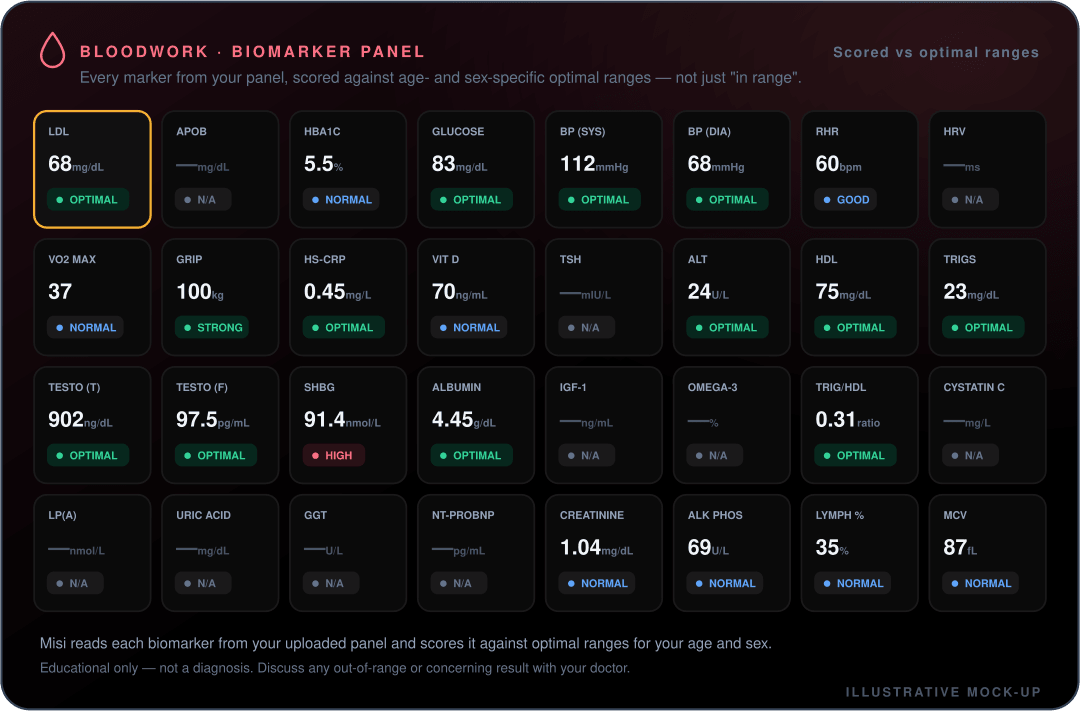
Here is the trap: some people carry a large number of small, cholesterol-poor LDL particles. Their LDL cholesterol can read normal while their particle count — and therefore their risk — is high. This "discordance" is especially common in people with insulin resistance, metabolic syndrome or high triglycerides. They are reassured by a normal LDL while their arteries are exposed to a high particle burden. ApoB resolves the contradiction (Sniderman 2019, JAMA Cardiology).
The causal case is strong
This is not a fringe view. The European Atherosclerosis Society consensus (Ference 2017) laid out the evidence that LDL — and the ApoB particles carrying it — is causally linked to cardiovascular disease in a dose-dependent way: cumulative exposure to these particles over a lifetime is a primary driver of atherosclerosis. Lowering the particle burden lowers risk. That is why measuring the particles directly, rather than inferring them from cholesterol content, matters.
How Misi puts it in context
A single marker in isolation rarely tells the story. Misi combines your lipids with an ASCVD 10-year risk estimate, your insulin-resistance markers (HOMA-IR and TyG), blood pressure and history, then tracks them over time. So instead of a one-off "normal LDL," you see whether your particle burden and overall cardiovascular risk are actually trending in the right direction — and the executive clinical report puts it all in one document you can take to your doctor.
A normal LDL cholesterol is not the same as low risk. ApoB counts the particles that actually cause heart disease — and sometimes they tell a very different story.
This is general information, not medical advice. Decisions about cardiovascular risk and treatment belong with your doctor, who can order an ApoB test and interpret it against your full history.
Ready to put this into practice?
Misi BioLabs turns your bloods into a meal plan, training block and AI coaching — in one place.
Start freeFree tools
- PhenoAge Calculator — Biological age from a standard blood panel (Levine 2018).
- Biological Age Calculator — How fast are you really ageing? Nine blood markers answer it — no quiz.
- VO2max Calculator — Cooper 12-minute test → VO2max + fitness age + mortality hazard.