1 min readTraining & Programming
Why you stopped getting stronger — and how to spot it early
A plateau rarely announces itself. By the time you feel stuck, you have usually been stuck for weeks. Here is how to catch it in the data before it costs you a month.
Part 29 of 38This article is part of the Training & Programming guideProgress in the gym is non-linear, which makes plateaus hard to see in the moment. One bad session feels like fatigue; three in a row feels like bad luck. It is only in hindsight that a true stall becomes obvious — usually after you have already wasted weeks grinding a programme that stopped working.
Estimated 1RM tells the real story
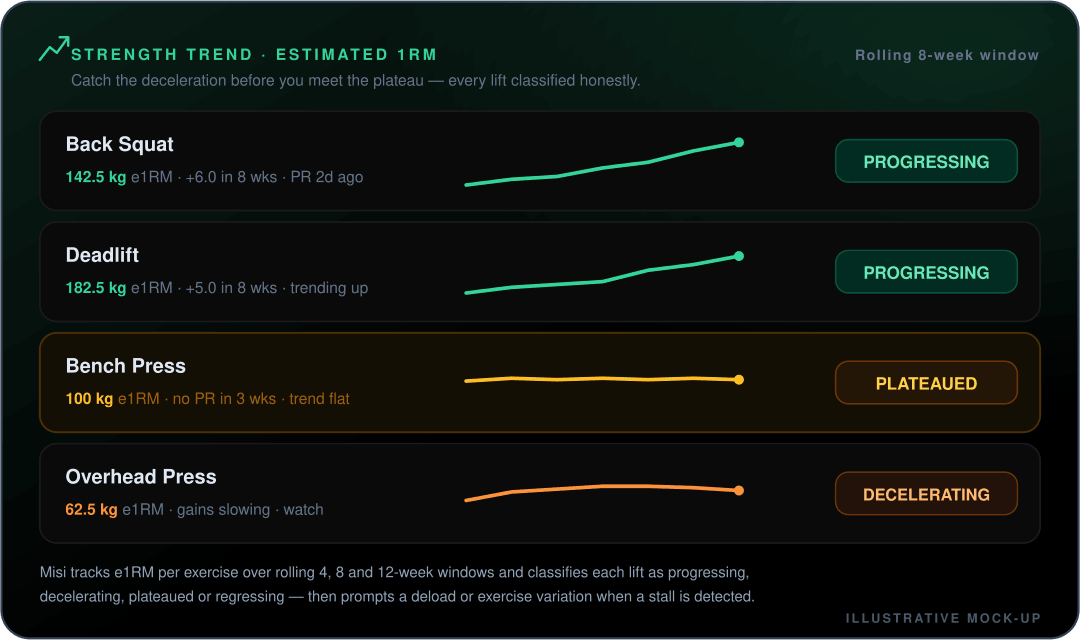
Rather than judging a lift by a single top set, Misi tracks your estimated one-rep max per exercise over rolling 4, 8 and 12-week windows. That trendline smooths out daily noise and reveals the actual direction of travel — up, flattening, or quietly sliding backwards.
Four states, named honestly
Misi classifies each lift as progressing, decelerating, plateaued or regressing. A plateau is flagged when you have set no personal record in three weeks and the trend has gone flat — the point at which more of the same is unlikely to help.
The fix is usually a change, not more effort
When a stall is detected, Misi prompts the obvious correction: a deload to clear accumulated fatigue, or an exercise variation to expose the muscle to a new stimulus. Both are routine tools — the value is being told to use them before frustration, not after.
Strength does not stall overnight. It decelerates first. Catch the deceleration and you rarely meet the plateau.
Ready to put this into practice?
Misi BioLabs turns your bloods into a meal plan, training block and AI coaching — in one place.
Start freeFree tools
- PhenoAge Calculator — Biological age from a standard blood panel (Levine 2018).
- Biological Age Calculator — How fast are you really ageing? Nine blood markers answer it — no quiz.
- VO2max Calculator — Cooper 12-minute test → VO2max + fitness age + mortality hazard.